

How to maintain hygienic wall surfaces: a facility guide

TL;DR:
Smooth, non-porous, seamless wall surfaces are essential to prevent microbial retention.
Proper installation, including sealed joints and coving, maintains long-term hygiene and reduces contamination risks.
Regular verification through testing and staff training ensures ongoing compliance and effective hygiene.
Wall surfaces are among the most overlooked vectors for cross-contamination in healthcare and food environments. A single gap in a joint, a rough tile grout line, or a missed terminal clean can create conditions that fail an audit or, worse, contribute to a hygiene incident. Regulatory bodies including the CQC, FSA, and NHS estates teams expect smooth, non-porous, easy-to-clean walls as a baseline, not a bonus. This guide walks facility managers through the material requirements, installation essentials, cleaning protocols, and verification systems needed to meet those expectations with confidence.
Table of Contents
Key Takeaways
Point | Details |
Prioritise seamless materials | Choose smooth, non-porous, certified cladding for maximum hygienic performance in any facility. |
Implement effective cleaning routines | Establish risk-based daily and terminal cleaning protocols with approved disinfectants and diligent record-keeping. |
Audit and improve constantly | Use ATP or visual audits, update procedures regularly, and train teams to stay ahead of compliance and hygiene risks. |
Design for hygiene, not just clean-up | Good wall hygiene starts with proper system design, seamless installation, and proactive maintenance measures. |
Understanding hygienic wall surface requirements
With the stakes clear, it is essential to understand what makes a wall surface truly hygienic. The answer goes well beyond appearances.
Surface roughness is a critical starting point. Microbial retention increases significantly once surface roughness exceeds Ra 1.6 µm, which is why food and healthcare environments demand finishes well below this threshold. Smooth, non-porous surfaces minimise microbial retention and support effective cleaning, a principle backed by laboratory evidence. Even modest surface irregularities can shelter bacteria from detergents and disinfectants, meaning the cleaning agent never actually reaches the organism.
Material selection follows directly from surface science. The most widely specified materials in regulated environments include:
Certified PVC wall cladding: Smooth, seamless, impact-resistant, and easily cut to eliminate joints
Fibreglass-reinforced plastic (FRP): Suited to higher-impact zones but requires careful joint sealing
Stainless steel: Common in food processing for heavy-duty areas, though costly and prone to condensation
Antimicrobial-additive panels: Useful as a supplement to standard cladding, not a replacement for physical cleaning
Understanding the key features of hygienic cladding helps you match material to environment before procurement begins.
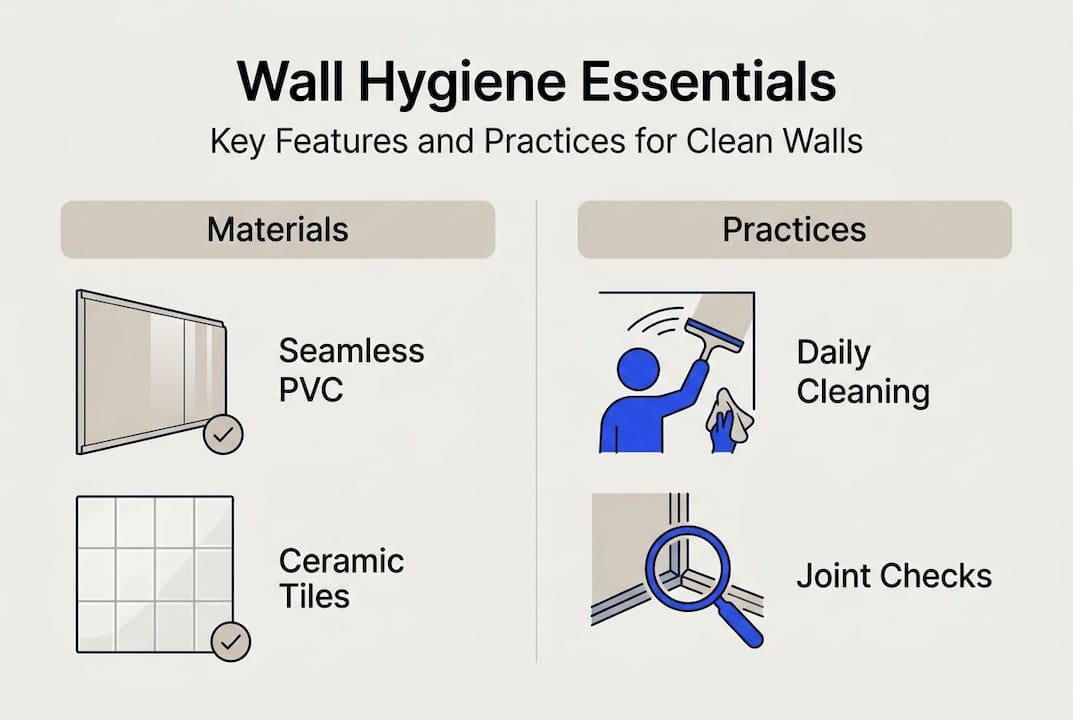
Tiles versus seamless PVC is a comparison worth making explicitly. Ceramic tiles, once an industry standard, carry a significant liability: grout. Grout lines are porous, difficult to clean consistently, and prone to cracking over time. Seamless PVC cladding eliminates this weak point entirely. Where tiles require re-grouting every few years, PVC panels installed with welded or fully sealed joins can sustain hygienic integrity for a decade or more with routine maintenance.
Feature | Ceramic tiles | Seamless PVC cladding |
Surface porosity | High (grout lines) | Non-porous |
Ease of cleaning | Moderate | High |
Joint risk | Significant | Minimal when sealed |
Impact resistance | Low | Moderate to high |
Lifecycle cost | Higher (re-grout, repair) | Lower |
Compliant materials should meet international standards including EHEDG, FDA, and HACCP frameworks. The EHEDG design principles provide detailed guidance on hygienic surface design that informs procurement decisions across sectors. Reviewing UK cladding standards alongside these international frameworks gives you a complete compliance picture.
Statistic to note: Studies report that surface roughness above Ra 1.6 µm can increase bacterial attachment by up to 40% compared to smoother finishes, underlining why material specification is a hygiene decision, not just an aesthetic one.
Preparing for effective hygiene: design and installation essentials
Having defined what to look for in wall materials, it is vital to install them with care to preserve their hygienic qualities. Even the best panel is undermined by poor workmanship.
Proper sealing of joints, coved skirtings, and corners prevents dirt traps and moisture ingress that compromise long-term hygiene. These are not aesthetic decisions. They are structural hygiene decisions made at the installation stage that affect every clean thereafter.
Key installation features for compliance:
Seamless or welded joins: Butt-joined panels with silicone sealant are the minimum; thermally welded or lipped trim systems are preferable for critical zones
Coved skirtings: The floor-to-wall junction is a primary harbourage point. Coved skirtings eliminate the right-angle corner entirely
Sealed service penetrations: Pipes, conduits, and fixings must be fully sealed with chemical-resistant sealant rated for the cleaning agents you use
Rounded internal corners: Avoid 90-degree internal corners wherever possible. Use pre-formed corner trims or radius-coved profiles
Correct panel height: Ensure cladding extends to the required height for the zone, typically full-height in food processing and at least 2 metres in patient areas
Common installation pitfalls include leaving gaps above suspended ceilings where panels meet, using standard silicone instead of food-safe or hospital-grade sealant, and failing to seal the backs of panels in wet areas, which allows moisture to wick behind and cause mould growth.
For wall cladding in hospitals specifically, the requirements extend to impact resistance near bed bays, chemical resistance to sporicidal agents, and colour-coding by zone for cleaning staff. These are design decisions that must precede installation.
Lifecycle costs are reduced significantly with quality, compliant materials over time. A cheaper panel installed without coving or proper joint sealing will require remediation within two to three years, whereas a correctly specified and installed system can run for ten or more years with minimal intervention. Cleanroom wall finish guidance reinforces this point: sealing and surface integrity at installation are foundational to ongoing contamination control.
Pro Tip: Before sign-off on any new installation, carry out a water test along all joints and penetrations. If moisture can get in, so can bacteria.
Daily and deep cleaning: best practices for ongoing hygiene
Once the wall system is in place, the challenge shifts to consistent and verifiable cleaning across different facility contexts.
Routine daily cleaning procedure:
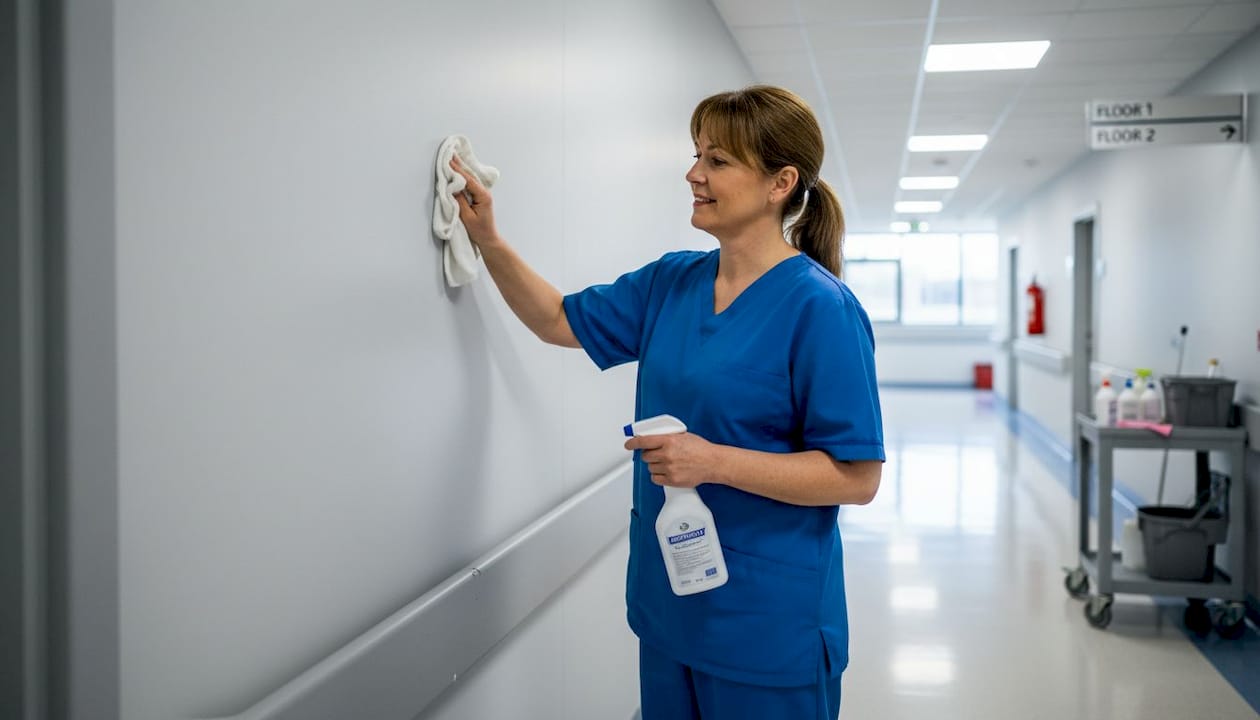
Pre-clean: Remove visible soiling with a dry or damp cloth before applying any chemical
Apply detergent solution using a clean, colour-coded cloth or mop system from high to low, top to bottom
Allow correct contact time per product specification, typically 30 to 60 seconds
Rinse with clean water if required by the product data sheet
Dry surfaces to prevent residual moisture that could support microbial growth
Daily cleaning should use approved hospital-grade disinfectants, with heightened frequency in high-risk zones such as isolation rooms, food preparation surfaces, and patient bay walls. A minimum of twice daily for high-contact areas is the accepted standard in most NHS and FSA-aligned protocols.
Terminal and deep cleaning requires a more structured approach. Sporicidal agents and ATP or fluorescent monitoring are required for terminal cleans in healthcare settings, particularly post-discharge or after a confirmed infection event. ATP bioluminescence testing gives you a quantifiable result in seconds, removing subjectivity from the verification step.
“A clean that cannot be verified is not a clean that can be relied upon.” This principle should underpin every terminal cleaning programme.
Disinfectant selection and rotation matters more than many facilities acknowledge. Bacterial resistance to quaternary ammonium compounds (QACs) is a documented concern. Rotating between bleach-based, QAC, and alcohol-based agents on a scheduled basis reduces the risk of adaptive resistance developing on wall surfaces over time. Check compatibility with your cladding material before introducing any new agent. The benefits of hygienic cladding include chemical resistance that most standard painted walls simply cannot match.
Pro Tip: Create a laminated cleaning matrix that lists approved agents, contact times, and correct dilutions for each zone. Attach it to the cleaning trolley. Guesswork during a terminal clean is a compliance risk.
Compliance logs should capture date, time, operative, product used, concentration, and ATP result where applicable. These records are what auditors will review first. Ensure your hygiene and compliance essentials documentation is always audit-ready and stored accessibly.
Verification and continuous improvement strategies
With daily effort invested, ongoing verification is critical to sustaining compliance and driving genuine improvement over time.
Routine audit methods:
ATP swab testing: Quantifies organic residue on surfaces post-clean. Benchmarks vary by sector but anything above 100 RLU in a food zone warrants investigation
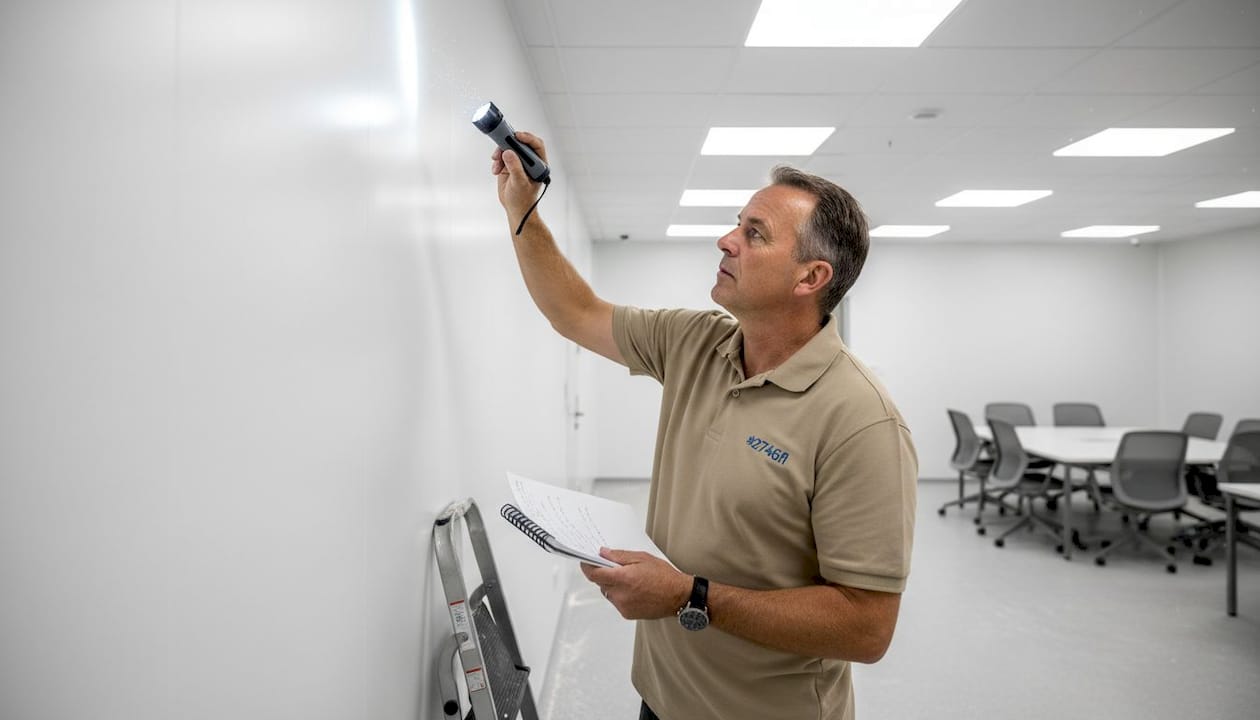
Fluorescent marker audits: Apply invisible marker before cleaning; inspect under UV light to verify coverage and technique
Visual inspection checklists: Structured walk-throughs of all wall surfaces, joints, penetrations, and skirtings at defined intervals
Photography log: Dated photographs of problem areas create an evidence trail for improvement and contractor accountability
Ongoing risk assessments, staff training, and robust documentation underpin compliance in every regulated environment. Without these three elements working together, even a well-specified wall system will drift out of acceptable condition.
Staff training is often underestimated. Cleaning operatives need to understand not just the procedure but the reasoning behind it. A member of staff who understands why coving must be cleaned differently from a flat panel, or why the mop direction matters, is far more likely to perform the task correctly under pressure.
Benchmarks including ATP thresholds, passive antimicrobial performance, and record-keeping should be reviewed annually and updated whenever a product, material, or process changes. Foam cleaning data from 2026 research suggests that foam-applied agents achieve more consistent wall contact than spray methods, a practical finding worth incorporating into deep-clean procedures.
Verification method | Frequency | Threshold for action |
ATP swab testing | Post every terminal clean | Above 100 RLU (food), 200 RLU (general) |
Fluorescent marker audit | Monthly | Any missed areas trigger retraining |
Visual inspection | Weekly minimum | Visible soiling or joint failure |
Material condition review | Annually | Cracks, lifting panels, or sealant failure |
Troubleshooting persistent contamination starts with protecting high-risk spaces by reviewing joint integrity first, then cleaning technique, then chemical selection. Rarely is the panel itself the problem. Usually, it is a gap in process or a physical defect created after installation. Understand what hygienic cladding is designed to do, and you will know where to look when it appears to be failing.
A different perspective on maintaining hygienic walls
Most hygiene conversations in facilities management gravitate towards products: which panel, which disinfectant, which monitoring system. These are important. But they are not the primary variable.
The facilities we see perform best over time are not always the ones with the most advanced materials. They are the ones where hygiene is treated as an active, ongoing commitment rather than a specification to be achieved and forgotten. The wall system provides the conditions for hygiene. The people within it deliver it.
Antimicrobial additives and passive features are helpful supplements, but they will not compensate for a cleaning operative who rushes a terminal clean, or a manager who has not reviewed incident logs in six months. Exploring the full benefits of hygienic wall cladding means understanding that the material is an enabler, not a guarantee. Invest in training, review cycles, and a facility culture where people speak up when something looks wrong. That investment returns more value than any product upgrade alone.
Find the ideal hygienic cladding solutions for your facility
For managers ready to act, premium products and guidance can further enhance wall hygiene strategies across healthcare, food, and commercial environments.
Whether you are specifying a new build, upgrading an existing facility, or responding to an audit finding, our range of PVC wall cladding solutions is designed to meet the demands of regulated environments. From full-height panels to ceiling cladding, we supply everything needed to create a seamless, compliant wall system. Our range of adhesives and accessories including trims, corner joints, and sealants ensures that every installation detail is covered. Contact our team for tailored product advice and support matched to your specific facility requirements.
Frequently asked questions
What makes a wall surface hygienic?
A hygienic wall surface is smooth, non-porous, chemically resistant, and seamlessly installed to prevent harbourage of contaminants. Physical surface characteristics matter as much as the cleaning regime applied to them.
How often should walls in healthcare and food facilities be cleaned?
High-touch walls should be cleaned at least twice daily in patient or critical zones, with terminal cleans after discharges or production cycles. Risk-based frequency should be documented and reviewed regularly.
What cleaning agents are safest and most effective?
Use hospital-grade disinfectants approved by your national health authority, including bleach, quaternary ammonium, or alcohol-based solutions, and rotate between agent types to reduce adaptive bacterial resistance.
Do antimicrobial additives replace regular cleaning?
No. Antimicrobials supplement but do not replace regular physical cleaning and disinfection. They are a secondary layer of protection, not a substitute for structured cleaning programmes.
How should compliance with hygiene standards be documented?
Maintain logs of routine cleans, terminal cleans, inspection results, and material compliance certificates for audit readiness. Records should be accessible, dated, and reviewed at defined intervals.
Recommended


Comments